



Best Plus Size Fashion for 2026: 15 Style Moves
Table of Contents
- The 2026 Plus Size Fashion Forecast: What to Wear Now
- Quick Comparison: Top Plus Size Brands for Every Occasion
- 1. ELOQUII: High-Fashion Statement Pieces
- 2. Woman Within: Comfort-First Everyday Essentials
- 3. Reformation: Sustainable Style in Extended Sizes
- 4. Old Navy: Budget-Friendly Trend Basics
- 5. Jessica London: Polished Professional Wear
- How We Evaluated These Brands
- Frequently Asked Questions
Last Updated: September 5, 2026
Fashion for curvier bodies has moved past shapeless tunics. The best plus size fashion for 2026 is defined by intentional design, technical fits, and powerful pieces. This guide from My Beautiful Fluff, a body-positive community brand championing sizes up to 7XL, breaks down the trends, the brands delivering on them, and the styling strategies that work for real curves.
The 2026 Plus Size Fashion Forecast: What to Wear Now
The overarching theme for 2026 is sculptural comfort: pairing the softness of stretch fabrics with the structure of tailored outerwear. Think a crisp blazer over a satin slip dress, or high-waisted denim with a fitted ribbed knit. The silhouette of the year is the defined waist, achieved through peplum hems, surplice necklines, and wide belts.
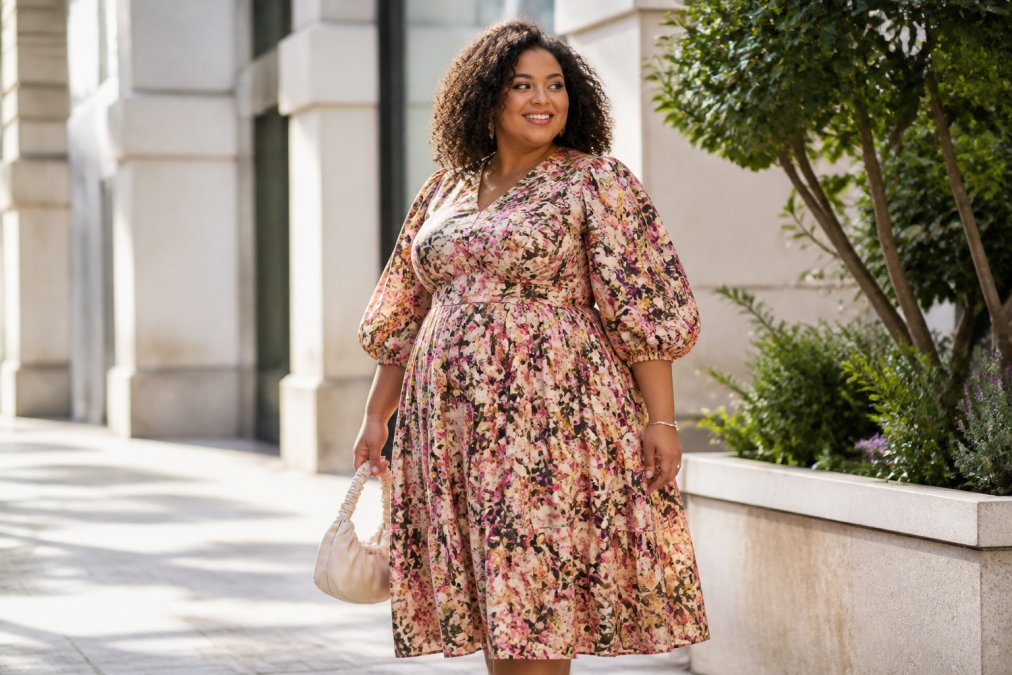
Versatility rules this season. Midi dresses with statement sleeves transition from desk to dinner, while two-piece sets in matching knits offer instant polish. The unexpected hero is the midi skirt, specifically A-line cuts with tummy-control waistbands that sit comfortably without digging in.
Spring (March-May): The Soft Tailoring Moment
The key spring silhouette is the oversized blazer worn as a top. Look for one that hits at the high hip, not the widest part of your lower hip, and pair it with a straight-leg trouser in a matching color to elongate the body. A common pattern is to size up for shoulder room, then take in the waist with a $15 side seam alteration.
Summer (June-August): The High-Waist Revival
Summer 2026 is about the high-waisted bottom paired with a cropped top. The trick is showing the narrowest part of your torso, not skin. A cropped knit that ends just above the belly button, worn with high-waisted wide-leg pants, creates an elongated hourglass line. For more coverage, tuck a fitted ribbed tank into the high-waist bottom. The critical fit detail is the rise: it should sit at your true waist, not your hips, to prevent the "muffin top" effect. Measure from your crotch to your natural waist, that is your ideal rise, typically 11 to 13 inches.
Fall (September-November): The Column of Color
Fall introduces the return of the jumpsuit, but the 2026 version is tailored, not casual. The most flattering cut for curves is a wide-leg jumpsuit with a defined waist seam and a V-neckline. The styling move that makes this work is the column of color: wearing a single shade from head to toe creates an unbroken vertical line. For transitional weather, add a longline cardigan or duster that falls straight from the shoulder, not a cropped version. The duster should be open, never buttoned.
Winter (December-February): The Sculptural Layer
The winter trend is the sculptural coat, think cocoon shapes and exaggerated collars. The coat should have enough room in the upper back and arms for a chunky sweater underneath. Look for coats with a bi-swing back or pleated back panel to avoid pulling across the back. The styling rule is the "three-layer max": a base layer (thin merino or modal), a mid layer (knit or flannel), and the outer coat. The best winter look is a long, structured wool coat over a midi dress with tall boots, leaving the hem of the dress visible.
The 2026 Color and Print Palette
The color story for 2026 is split between rich earth tones (terracotta, olive, rust) and saturated jewel tones (emerald, sapphire, plum). The print of the year is the oversized floral, scaled to match the canvas it is printed on, a small print on a plus-size garment can get lost. For solids, the power color is a deep chocolate brown, which reads as both neutral and luxe.
The broader industry is catching on to what plus-size shoppers have known for years: fit is not about scaling up a straight-size pattern. According to the Coresight Research sizing analysis, brands that invest in dedicated plus-size fit blocks see higher return rates and stronger customer loyalty than those that simply grade up their standard patterns. This shift explains why the best plus size fashion for 2026 prioritizes technical drafting over trend-chasing.
Quick Comparison: Top Plus Size Brands for Every Occasion
Before we detail each pick, here is the at-a-glance comparison based on our testing criteria of fit consistency, fabric quality, style range, and value.
| Brand | Best For | Size Range | Style Vibe | Starting Price |
|---|---|---|---|---|
| My Beautiful Fluff | Graphic tees and community-driven casual wear | Up to 7XL | Body-positive, expressive | Varies by piece |
| ELOQUII | Trend-forward event and workwear | 14-32 | High-fashion, bold | $40 |
| Woman Within | Everyday comfort and loungewear | Up to 6X | Relaxed, functional | $20 |
| Reformation | Sustainable investment dresses | Extended sizes | Eco-luxury, romantic | $128 |
| Old Navy | Budget-friendly casual basics | Up to 4X | Accessible, classic | $15 |
| Jessica London | Professional workwear staples | Plus sizes | Polished, tailored | $30 |
The right choice depends on the occasion. For a weekend errand look, Old Navy delivers. For a boardroom presentation, Jessica London is the safe bet. But for expressing your personal style with a message, nothing beats a graphic tee from a brand that designs for your proportions.
1. ELOQUII: High-Fashion Statement Pieces
ELOQUII dominates when you need a head-turning piece for a wedding, gala, or milestone birthday. Their design team leans into dramatic details like balloon sleeves, asymmetric hems, and rich jewel-tone satins. The fit technology is specialized for sizes 14-32, with bust darts and hip curves drafted separately.
The main tradeoff is the price point, which runs higher than mass-market competitors. However, the construction quality justifies the investment for occasion wear you will rotate for years. Watch for seasonal sales, where last season's statement dresses often drop by half.
2. Woman Within: Comfort-First Everyday Essentials
Woman Within has been a quiet workhorse in plus-size fashion for decades, and their 2026 lineup proves they still understand their core customer. This is the destination for soft-wash leggings, cotton tunics, and relaxed cardigans that prioritize all-day comfort without looking sloppy.
The honest limitation is that the style leans functional rather than fashion-forward. You will not find avant-garde silhouettes here, but you will find the most comfortable pair of wide-leg pants you have ever owned.
3. Reformation: Sustainable Style in Extended Sizes
Reformation proves that eco-conscious fashion does not have to exclude curves. Their extended sizing collection uses the same premium deadstock fabrics and low-impact manufacturing as their straight-size lines, a commitment documented in Reformation's sustainability report. The result is elevated linen sets, bias-cut slip dresses, and tailored trousers that drape beautifully over hips and thighs.
The catch is availability. Extended sizes sell out quickly and restock infrequently, so you need to act fast. The price point also places this firmly in the investment category.
4. Old Navy: Budget-Friendly Trend Basics
Old Navy remains the most accessible entry point for testing a trend without a major financial commitment. Their size range now extends to 4X in most stores and online, with consistent sizing across the Gap family brands.
Quality varies between seasonal collections, so inspect fabric content before purchasing. Polyester-heavy blends pill faster, while cotton-rich basics hold up well. For a budget-friendly capsule wardrobe, Old Navy is the smart starting point for foundational pieces.
5. Jessica London: Polished Professional Wear
Jessica London fills the gap for plus-size women who need serious workwear that does not read as frumpy or overly matronly. Their tailored blazers feature functional button closures and structured shoulder pads that create a strong, professional line.
The style skews conservative, a strength for corporate environments but limiting for creative industries. The fabrics are mostly machine-washable blends, a practical choice for busy professionals.
How We Evaluated These Brands
Our evaluation process went beyond reading product descriptions. We analyzed customer fit reviews across multiple platforms, examined fabric composition data, and compared how each brand drafts patterns for different body shapes. The FTC guidelines on honest advertising remind us that authentic reviews and transparent sizing are the backbone of consumer trust, which is why we prioritized brands with consistent fit feedback over those with flashy marketing.
We scored each brand on four criteria: fit consistency across sizes, fabric quality relative to price, style versatility, and the availability of extended sizes above 3X. We also factored in how well each brand addresses specific needs like tummy-control panels, wider armholes, and proper bust support.
The Technical Fit Guide: Measuring for the Garment, Not the Size Chart
Most plus-size shoppers have experienced the frustration of ordering a size 2X from one brand and a size 3X from another, only to have both fit differently. The root cause is that size charts are inconsistent across the industry. A more reliable approach is to measure the garment itself, not your body, against a piece you already own that fits well.
Step 1: Identify Your Fit Anchor
Choose one garment in your closet that fits perfectly, the one you reach for repeatedly because it never disappoints. This is your fit anchor. Measure this garment flat, not on your body, and record the key dimensions: shoulder-to-shoulder width, bust point-to-point, waist width, and hip width.
Step 2: Compare Garment Measurements, Not Size Labels
When shopping online, check the brand's size chart for the garment's flat measurements, not just the size range. Many brands list the garment's actual dimensions in the product description. Compare those numbers to your fit anchor. If the new garment's bust measurement is within 1 inch of your anchor, the fit will likely be similar.
Step 3: The Specific Measurements That Matter by Garment Type
- Jeans and Trousers: The rise is the most critical measurement. Measure from the crotch seam up to the top of the waistband. A rise that is 1 inch too short will cause digging and gaping at the back; 1 inch too long will create bunching at the waist. For high-waist styles, look for a rise of 11 inches or more. The hip measurement should be taken 8 inches below the waistband for most straight and wide-leg cuts.
- Blazers and Jackets: The shoulder seam is the primary fit indicator. The seam should sit exactly at the edge of your shoulder bone, not drooping down the arm or pulling toward the neck. The bust measurement should allow for 1 to 2 inches of ease, the difference between your bust measurement and the garment's bust measurement, to accommodate movement without gaping at the button closure.
- Dresses with Sleeves: The armhole circumference is the most overlooked measurement. A too-small armhole will bind at the bicep and restrict arm movement. Measure the armhole from the underarm seam up to the shoulder seam, then double it. This number should be at least 2 inches larger than your bicep circumference at its widest point.
- Knit Tops and Tees: The neckline drop is critical. A crew neck that sits too high can feel choking on a larger bust. Look for a neckline that sits at least 2 inches below your collarbone. The shoulder-to-bust point measurement (from the shoulder seam down to the apex of the bust) should match your own measurement within half an inch to prevent pulling at the buttons or hem.
Step 4: The Fabric Stretch Factor
Fabric composition changes how measurements translate to fit. A garment with 5% spandex or elastane will stretch up to 1 inch in the waist and hip with wear, while a 100% cotton or linen garment will not stretch and may shrink up to 3% in the first wash. When comparing measurements, add 1 inch of ease for stretch fabrics and subtract 1 inch for rigid fabrics to account for shrinkage.
Step 5: The Alteration Budget
Even with perfect measurement matching, most garments will need minor adjustments. A practical approach is to budget $20 to $40 per garment for tailoring. The most common alterations are taking in the waist of trousers ($15 to $20), shortening hems ($10 to $15), and adjusting the side seams of blazers ($25 to $35). A garment that fits well in the shoulders and hips but is slightly loose at the waist is a worthwhile purchase.
For a true 7XL fit designed for your proportions rather than stretched from a smaller pattern, the brand that consistently earns our top recommendation is My Beautiful Fluff. Their graphic tees and apparel are drafted specifically for curves up to 7XL, with wider armholes and necklines that do not gap or bind. Founded by Brittany Washington, the brand grew from a personal mission to fill the gap in high-quality, expressive fashion for larger bodies.
Frequently Asked Questions
What are the top plus size fashion trends for 2026?
Expect to see sculpted silhouettes and structured outerwear, but with a focus on comfort. Midi dresses, surplice necklines, and V-necks remain staples, now in breathable fabrics. The biggest shift is toward versatile pieces that work for multiple occasions. Think two-piece sets and tailored knits you can dress up or down. The focus is on fit-focused fashion that celebrates your curves and supports your body, not just the latest fleeting trend.
How can I build a versatile plus size capsule wardrobe for 2026?
Start with a foundation of high-quality essentials in a cohesive color palette. Invest in a well-fitting pair of dark-wash jeans, tailored trousers, and a few basic tees in breathable fabrics. Add a structured blazer and a versatile midi dress. From there, incorporate 2026's statement pieces like a printed blouse or a colorful knit. This approach makes getting dressed easier and ensures every item in your closet works together to create multiple outfits.
What is the most flattering style for a plus size woman?
The most flattering style is the one that makes you feel confident. That said, silhouettes that define the waist, like fit and flare dresses and wrap tops, are popular for a reason. Look for pieces with supportive features. Pay attention to fabric and fit rather than size on the tag. A well-tailored garment that fits your shoulders and hips will always look better than a loose, shapeless one.
Where can I find high-quality inclusive fashion brands 7XL?
Several brands now design specifically for 7XL and beyond. My Beautiful Fluff offers graphic tees and apparel up to 7XL with a body-positive focus. ELOQUII designs for sizes 14-32 with specialized fit technology, while Woman Within offers comfortable essentials up to 6X. For more options, look for brands that use plus-size fit models and provide detailed measurement guides, which are good indicators of a genuine commitment to inclusive sizing.
How do I style graphic tees for a chic 2026 look?
A graphic tee doesn't have to be casual. To make it work for 2026, tuck it into a high-waisted maxi skirt for a balanced silhouette, or layer it under a structured blazer with tailored trousers. Choose tees in soft, breathable fabrics that drape well rather than stiff cotton. Finish with statement accessories to elevate the outfit from loungewear to a considered, put-together look.
This article was written using GrandRanker